
This newsletter contains links to pages and documents on the LWVCC website: .
Before opening these links, please ensure that you are logged in to www.lwvcolliercounty.org.
| Message from the President
|
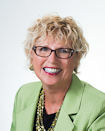
LWVCC President
Teresa Stohs
Get Your Yes’s Out to Vote
How do we “move the needle?” Some years ago, I worked for the Kansas City Public Library system. We had some significant capital needs and decided to ask for a mill levy increase. Historically, the Library had never won a mill levy first time out, so we hired a highly respected local political consultant.
At our first meeting, he said something that has profoundly impacted my career and personal life ever since. He said, “It is not getting the no’s to say yes, it’s getting the yes’s out to vote.”
So that is my challenge to you as we approach late summer Midterm and fall Primary elections. Get your yes’s out to vote! Never underestimate the importance of local elections. These are the issues and decision-makers that affect your day-to-day life.
Our Annual Meeting is scheduled for 10 am on April 13 at Tiburon. I hope you will attend and vote for the direction of the LWVCC for 2026-2027. Also, please take advantage of the opportunity to meet our LWVFL President, Jessica Lowe-Minor, at our April 13th General Meeting. She will be talking about Bringing Floridians Together.
Register for Meeting
 | The Link between Florida Driver License/Identification Card and Voting | By Monica Elliott, LWVFL Voter Services Chair
Note: The following is an abridged version of the complete document posted on the LWVCC website.
As I write this, the Election Integrity bill (HB 991/SB 1334) has just been passed by both the Florida House and the Senate. It will become law unless the Governor were to veto the bill. In the meantime, let’s look at the current and potential relationship between your Florida Driver License/Identification Card (DL/ID) and voting.
Your Florida DL/ID is a REAL ID!
“The REAL ID Act became effective nationwide on May 11, 2008. Florida began issuing REAL ID compliant credentials after January 1, 2010. Florida is a REAL ID compliant state and all Florida licenses should be accepted nationwide.”
Obtaining Your REAL ID
For U.S. citizens, HB 991/SB 1334 requires a primary form of identification, e.g., birth certificate, passport, etc. If a person changed their last name from the one on their birth certificate, documentation of that name change, e.g., a marriage certificate, is required.
For non-U.S. citizens, additional identification is required, depending on their status as an immigrant, non-immigrant, or Canadian.
FLHSMV has your legal status on file!
If you possess a Florida DL/ID, Florida Highway Safety and Motor Vehicles (FLHSMV) already has your legal status in their (hopefully secure) database.
U.S. citizens unable to vote?
The problem, of course, will be for those U.S. citizens who do not possess a Florida DL/ID.
If HB 991/SB 1334 becomes law, the SOE will have to verify the citizenship status of every new voter registration applicant before the application is processed by “pinging” the FLHSMV database. If the SOE can’t find a database that confirms you are a U.S. citizen, you will have to provide those primary forms of identification to prove citizenship.
Another NEW DL/ID Card
If HB 991/SB 1334 becomes law, by July 1, 2027, the state will begin replacing our current DL/ID cards with NEW ones which will indicate legal citizenship status directly on the card!
Confused? Help the young voters!
Encourage every voter to obtain a Florida DL or ID card. This is especially important for young voters, as only about 56% of young people obtain a driver license anymore. If you know a young person, help them obtain a DL or ID.
Please see the full article posted on the LWVCC website for more details. | Bringing Floridians Together
Democracy Needs Civility | Bringing Floridians Together is a League of Women Voters of Florida initiative that focuses on fostering stronger community connections through cultural and civic engagement while working to unite residents across diverse backgrounds and beliefs.
At a Greater Naples Leadership event entitled “Reduce the Rancor: A Free Community Forum on Civility," panelist Rev. Dr. Sharon Harris-Ewing of the Interfaith Alliance of Southwest Florida was asked, “What do you think are the necessary conditions for civility to be possible?” Her response is presented below.
"Civil discourse requires that we share some specific values and skills.
First, we must all affirm the fundamental value of every person, the belief that every single human being is inherently worthy of respect, dignity, and civil rights—equal rights under the law. Acting on this value, we assume that others have something of value to offer us.
Second, civil discourse requires an open mind and open heart. An open mind means that I am curious; I seek to learn from others. I don’t assume I already know what they think or believe. An open heart means I strive to practice empathy. I want to see the world through others’ eyes, to understand how their experiences have led them to think and feel the way they do.
Third, civility requires humility. I don’t know everything. I’m not always right. I can learn from you even if I disagree with you. If I am convinced that I’m right, I might appear to listen, but I’m not trying to understand or connect; I’m just waiting for you to finish.
Finally, for civil discourse to occur across real and meaningful differences, we have to value it. We have to believe in the value of entering into relationships with people who are different, building an inclusive community, and celebrating diversity. That leads directly to the skills required: listening, patience, and particular ways of thinking.
Listening is a skill that can be practiced and improved. There’s an old adage about one mouth and two ears. We would do well to speak less and listen more. We need to listen to learn: to understand a different point of view, to see from another’s perspective, and to learn about others’ experiences.
Being patient is also a skill that can be practiced and improved. Responding with patience may mean silencing our knee-jerk reactions, taking a deep breath, bearing with someone as she tries to explain herself or as he gathers his thoughts. Patience may mean slowing down one’s own response, thinking before speaking, and sometimes not speaking at all.
Critical, divergent, imaginative, and compassionate thinking is also a skill, one that takes hard work, but can be improved. It’s being able to think outside the box, specifically my own “box,” taking off whatever blinders limit my vision so that I can see both sides of an issue. It’s being willing and able to find common ground even when others say there is none.
In this coming election year, our community would be well served if more of us committed ourselves to developing these shared values and skills required for civil discourse. " | In Memory of Ann Campbell | |
It is with great sadness that we announce the passing of Lifetime Member of LWVCC, Ann Campbell. Active for decades, she chaired the Social Policy committee and was Co-President of the League from 1990 – 1991 and was President from 1991 – 1993. She was devoted to LWVCC, to educating League members, and to coordinating social services in Collier County, particularly for the elderly. She was 90 years old and celebrated that birthday with several of her LWVCC friends. | 
Voter Services Committee
Tina Palmese, Chair
Immokalee Fair Housing Alliance Annual Block Party
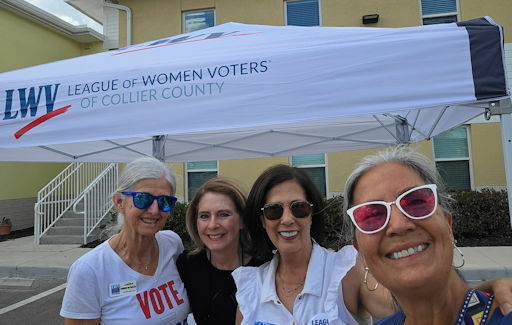
On Saturday, March 7, Voter Services Volunteers participated in the second annual Block Party, a celebration of the connection and the work of the Immokalee Fair Housing Alliance, which has built affordable homes for the hardworking residents of Immokalee. It was a fun-filled day with this vibrant community. Our volunteers, MaryJo Diegel, Susan Housel, Laura Hansen Reynolds, and Tina Palmese, distributed information on Vote By Mail, checked voter registration with our iPad and encouraged voters to be ready for this year's primary and general elections, all while providing fun giveaways and some treats!
Supervisor of Elections Transparency Tour
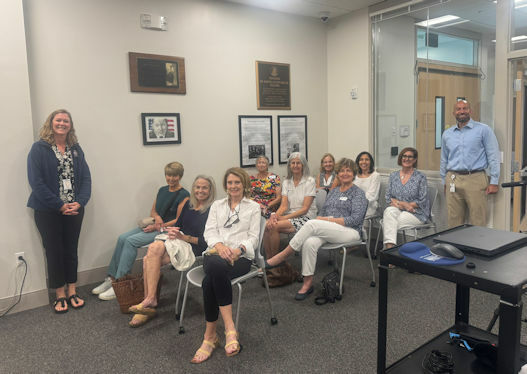
On Monday, March 23, twelve LWVCC members attended a Transparency Tour at the Collier County Supervisor of Elections Office. Conducted by Melissa Blazier and her staff, they had the opportunity to learn about the behind-the-scenes administrative operations and tabulation equipment--a highlight of which was a demonstration of the Vote-By-Mail sorting equipment. They experienced firsthand why Collier County has one of the top operations in Florida and the depth of the security measures in place that ensure the integrity of our elections.
|
Gun Violence Subcommittee
On February 18, 2026, Thomas Gabor, Ph.D., a professor of criminology for over 30 years and author of the illustrated book GUN VIOLENCE 101, presented to the Gun Violence Prevention subcommittee of the LWVCC. The book contains an incredible amount of information about gun violence and its impact on people. Notably, Tom says that half of all Americans have been personally affected by gun violence, getting caught in a mass shooting is the #1 fear of teens and young adults, and one-third of all Americans avoid certain places due to the fear of gun violence.
This information provides a prime opportunity to bring people closer in accordance with the League’s Bringing Floridians Together initiative. It’s important to tell our life experiences and tell your or another’s story, but even more, it is important to start listening to our neighbor’s experience first. Asking about what has occurred in their life to have them reach their opinion can get them away from sharing misinformation heard on the news. It’s also important to ask them what they value and for you to tell them what you value, such as freedom, respect for other people and safety. Once trust, safety and connection are established, then facts can be presented.
The Gun Violence Prevention subcommittee was honored to hear a presentation by Kathryn Fleisher, MPH, a policy advisor of the John Hopkins Center for Gun Violence Solutions at the Bloomberg School of Public Health. She spoke to the subcommittee about evidence-based solutions to the prevention of firearm suicides and ERPOs (Extreme Risk Protection Orders) (also known as red flag laws). Her fascinating presentation revealed important statistics about suicide and ERPOs in Florida: Gun violence is a public health crisis. It has been the leading cause of death in children (1-17 y/o) for four years running. In the US, one person is killed every three hours. And 6/10 of all deaths by firearm violence are suicides. In Florida, 70% of all deaths were firearm suicides.
Voters need to be educated about two major recommendations to prevent firearm deaths: 1) Safe and Secure Firearm Storage: gun lock/triggers or gun safes, 2) ERPOs (including domestic violence relinquishment): most people don’t know that citizens can report concerning behavior to law enforcement!!
If we all share our knowledge of just these two recommendations, we can prevent many deaths by gun violence. |
Environmental Affairs Committee
Lynn Martin, Patti Forkan, Co-Chairs
The March meeting of the Environmental Affairs Committee featured Logan Kennovin, Assistant Director of Habitat and Environmental Conservation with Coastal Conservation Association Florida.
The Collier Community Foundation has provided a $50,000 grant to CCA to establish a new artificial reef 10 miles off the coast of Naples. This reef will enhance marine biodiversity, mitigate coastal erosion and support local fishing and tourism. Locally, CCA has also been involved in planting mangroves at Delnor Wiggins State Park, planting oyster beds in Naples Bay, and seagrass projects.
Logan gave us an overview of CCA’s extensive habitat restoration activities throughout Florida, especially the fish stock enhancement program, the clam and oyster bed cultivation to improve water quality, coral restoration, and artificial reef deployments. Logan then explained that the CCA budget will match the Community Foundation grant, which will fund 40-45 prefab cone structures 10 miles offshore in 50 feet of water. These modules are 6 feet in diameter and 5.5 feet high. They will be placed during May and June 2026. If additional funding is provided, more modules will be placed. These reefs will reduce wave energy, create new habitat for marine species and develop recreational fishing and diving spots, thereby providing economic benefits in addition to storm protection. |
Membership Committee
Beth Van Damme, Chair
Welcome New Members!
Please join us in giving a warm welcome to our newest members:
|
| xxxxx |
Elizabeth Maldonado
|
xxxxxxxxxxxxxxxxxxxxxxxx |
| |
Anne Matz |
|
| |
Connie Preu |
|
| |
Laura Quintano |
|
| |
Elisabeth Teller |
|
| |
|
|
| We are excited to have you join our community! |
| League News From Across the Country
| National League News
For more information, visit LWV.org.
State League News
For more information, visit LWVFL.org.
| Please refer to the LWVCC Weekly Update for a complete list of upcoming events or visit the LWVCC website.
Members should log in to ensure they see members-only events and registration options. | Empowering Voters. Defending Democracy.
The League of Women Voters is a nonpartisan political organization that encourages informed and active participation in Government. We influence public policy through education and advocacy. Our goal is to empower citizens to take an active role in shaping better communities worldwide. The League of Women Voters of Collier County does not support or endorse any candidate or political party.
League of Women Voters of Collier County
P.O. Box 9883, Naples, FL 34101
Sent by lwvcc@lwvcolliercounty.org
| SUPPORT THE LEAGUE
|
Recurring Gifts
It’s easy to make a larger-than-average gift by giving smaller amounts monthly.
We now have the ability to accept recurring gifts. Click the donate button on our
homepage, and you will see options to give to the education fund or the endowment.
There are two buttons – Donate and Recurring Gifts.
You can make recurring gifts monthly or quarterly.
Give it a try!
|
| |